Sana Khalid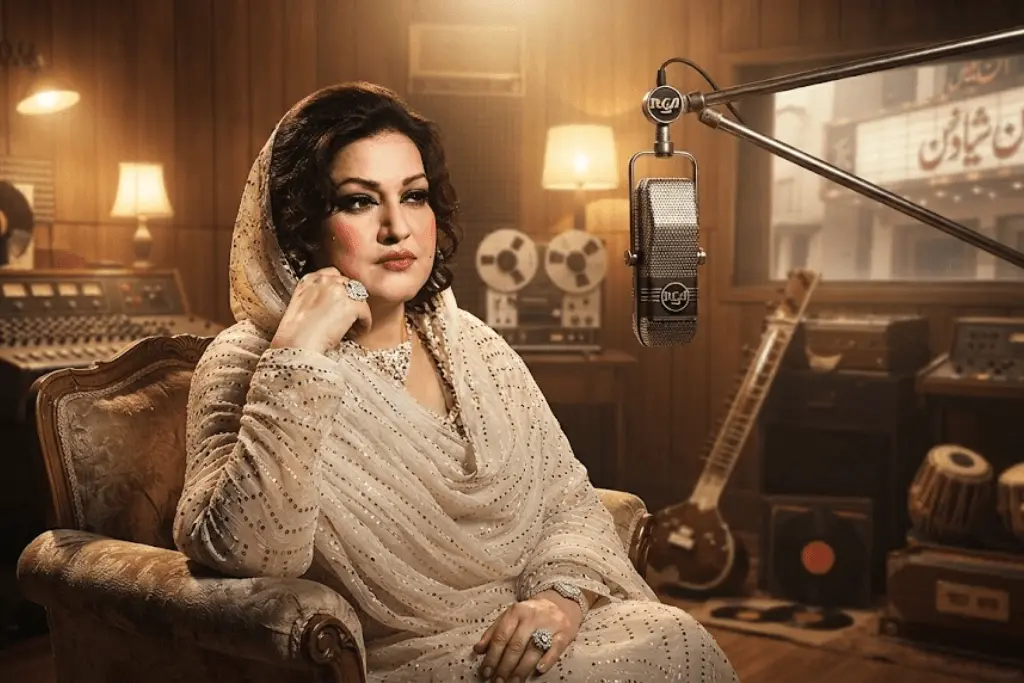
Born Allah Wasai in Kasur on 21 September 1926, Noor Jehan is one of the defining voices of Pakistani music. Her birth centenary in September 2026 has rekindled interest in an extraordinary career and her iconic Noor Jehan songs, which bridged pre-Partition Indian cinema and the growth of Pakistan’s film and music industries. She died aged 74 in Karachi on December 23, 2000, but her recordings continue to reach new generations.
Noor Jehan, or the Malika-e-Tarannum, or Queen of Melody, had a career spanning over six decades. Her recorded output is estimated by sources to be in the region of 10,000 songs in Urdu, Punjabi and Sindhi. She sang film music, romantic melodies, ghazals, folk-influenced songs and patriotic milli naghmay. Still, a huge part of her cultural value is her ability to move between different kinds of musical forms.
Her significance for the cultural identity of Pakistan became especially evident in the 1960s, when her patriotic recordings became strongly associated with national morale. At the same time, her earlier work in films and her later work in television showed that her appeal was never confined to patriotic music, and her voice remained relevant across different periods of Pakistani cultural history.
Aye Watan Ke Sajelay Jawano Becomes Patriotic Classic
Noor Jehan’s popular patriotic recording includes ‘Aye Watan Ke Sajelay Jawano’. The song was originally composed during the 1965 India-Pakistan war, when her voice was strongly linked with national broadcasts and songs to raise the morale of the public and the armed forces. The recording was part of a corpus of milli naghmay that remain closely associated with Pakistan’s cultural memory.
Noor Jehan’s patriotic work had a unique emotional quality to her singing that combined technical control with an expressive delivery that was appropriate for wartime poetry and national themes. Her performances were broadcast on radio and television, enabling the songs to reach audiences across Pakistan at a time of intense national mobilisation.
The constant celebration of Aye Watan Ke Sajelay Jawano shows how music can become associated with historical memory. The patriotic songs of Noor Jehan are identified with courage, sacrifice and national identity, giving the recordings a significance beyond their original film and broadcast contexts.
Mujh Se Pehli Si Mohabbat United Poetry And Melody
Mujh Se Pehli Si Mohabbat is another important aspect of Noor Jehan’s artistry as it merged the work of one of Urdu’s most powerful poets with one of the subcontinent’s most acclaimed voices. The nazm was penned by Faiz Ahmed Faiz, who penned poetry laced with themes of love, social consciousness and human experience. Noor Jehan’s performance helped to make the work a lasting musical interpretation of Faiz’s writing.
The song shows how Noor Jehan was able to deal with literary material without sacrificing its emotional character. She gave the poem a musical identity which allowed it to reach audiences outside the literary circles, yet it retained the seriousness and emotional depth associated with Faiz’s work.
The enduring popularity of the recording also speaks to the relationship between Pakistan’s literary and musical traditions. During her career, Noor Jehan collaborated with many leading poets and composers, turning some of the most important Punjabi and Urdu writings into songs that became part of popular culture for decades.
Awaaz De Kahan Hai Is A Tribute To Her Pre-Partition Fame
Awaaz De Kahan Hai is Noor Jehan’s contribution to the cinema of undivided India before the creation of Pakistan. The song is linked with the 1946 film Anmol Ghadi and represents the period when Noor Jehan was already among the top singers and actresses of Indian cinema.
She started her early career as a child performer, but her family eventually relocated to Calcutta, an important centre of the developing Indian film industry. She was a singer and an actress before the Partition, and her fame would later cross over into Pakistan.
Thus, the song has historical significance as well as melody. It was a time in the history of South Asian music when film songs were creating new forms of mass entertainment, and Noor Jehan was one of the performers who helped bring about this transition. Her pre-partition recordings are an important part of the foundation of her later career in Pakistan.
Chandni Raatein Features Noor Jehan’s Gentle Voice
In Chandni Raatein, Noor Jehan’s softer, intimate side emerges in her singing. The song, associated with the 1952 Pakistani film Dupatta, demonstrates the versatility that allowed her to shift easily from patriotic material to romantic songs, folk traditions and literary compositions.
The melody relies on emotional restraint, not the forcefulness that characterises some of her national songs. Noor Jehan’s restrained phrasing and distinctive vocal colour lent such pieces an intimate quality, and this partly explains why her romantic and film recordings remained popular long after their initial release.
Chandni Raatein also represents an important phase in the evolution of Pakistani cinema. After Partition, Noor Jehan moved to Pakistan and was one of the people who helped to build the new country’s nascent film industry. Her work as an actress and singer gave an important musical presence to early Pakistani cinema.
Aye Puttar Hattan Te Nahi Vikde Shows Punjabi Culture
Aye Puttar Hattan Te Nahi Vikde occupies a special place in the patriotic repertoire of Noor Jehan, due to its Punjabi language and emotional connection with family and sacrifice. The song was popularised as a song sung by the sons serving the country and gained prominence during the 1971 conflict.
This recording is a case in point of how Noor Jehan used to play national themes against familiar cultural sentiments. Rather than simply using formal patriotic language, the Punjabi song evoked notions of motherhood, family and sacrifice, which made its emotional message accessible to a broad audience throughout Pakistan.
Its impact was not confined to wartime broadcasts. Pakistan’s hockey team played the song later, and it was also part of the atmosphere in the build-up to major sporting events, Dawn reported. These examples demonstrate how Noor Jehan’s songs could go beyond cinema or broadcasting to be used in many ways to express a national and sporting culture.
Noor Jehan’s Voice Spanned Generations In Pakistan
The five songs are but a drop in the ocean of Noor Jehan’s vast repertoire. She recorded in several languages and musical traditions, including Urdu, Punjabi and Sindhi, and worked in cinema, radio, television and live performance. That spectrum made her music accessible to audiences of various cultural and linguistic backgrounds.
And she influenced later generations through TV, where she re-recorded her older songs and brought her unique style to those who did not see her in her early film career. Her talent for reworking older works kept songs that might have been stuck in old records alive.
So Noor Jehan’s legacy is not just a body of popular songs. Her career is woven into the cultural fabric of Pakistan, bridging nascent cinema, literary traditions, patriotic music, Punjabi culture and changing popular culture into a voice that still resonates decades after her death.