Farhan Qureshi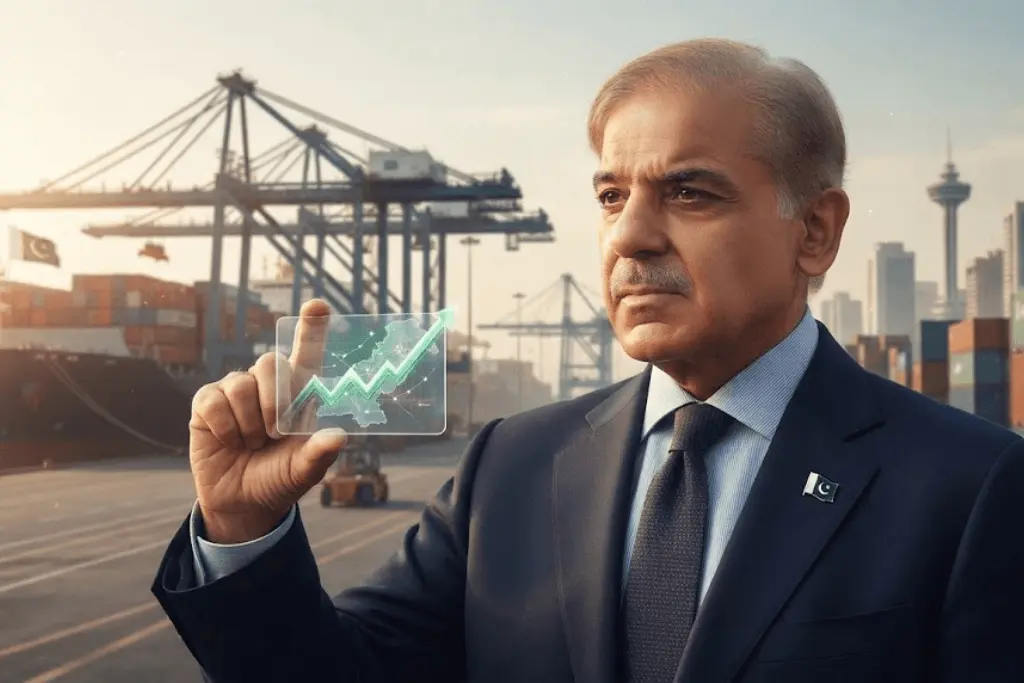
Prime Minister Shehbaz Sharif has directed the federal government to focus Pakistan’s economic development strategy on Pakistan exports growth. The directive was given at a review meeting to improve exports, expand international market access and speed up the pace of national economic growth.
The prime minister stressed that Pakistan needs to look beyond traditional export sectors and prepare a broader range of industries for the international markets. Trade diversification, strengthening foreign exchange earnings and opening new opportunities for businesses across the country are expected to be supported by more participation from different sectors and industries.
New Emphasis On Product Quality And Value Addition
Shehbaz Sharif directed the concerned institutions to bring the quality of Pakistani products up to international standards. Improved quality assurance systems and full compliance with international regulations were identified as important requirements for improving the country’s position in global trade.
International buyers are increasingly requiring consistent quality, reliable certification, safe production methods and compliance with technical regulations. Pakistani exporters therefore need to improve their standards of production, packaging, testing facilities and reliability of the supply chain. Meeting these requirements can help businesses enter new markets and retain existing customers.
Research And Innovation Technologies For Export Industries
The government has called for more use of modern technology, research and innovation in export-oriented industries. The prime minister stressed the need to use digitalisation and modern production methods to bring the national economy in line with changing international requirements.
Technology can help exporters increase manufacturing efficiency, reduce production waste and improve product consistency. Digital systems can also help with inventory management, customs documentation, payment processing, market research and communication with overseas buyers.
Gov’t Moves To Ease Export, Business Barriers
Prime Minister Shehbaz Sharif has directed the concerned departments to remove administrative and business hurdles faced by the exporters. This will make the export process easier, faster and more transparent for all businesses operating in Pakistan, the instructions said.
Exporters have to go through documentation, regulatory approvals, customs procedures, transportation, and delays in getting official clearances. These barriers can drive up costs and make Pakistani goods less competitive than those from nations with less complicated trade practices.
Pakistan To Explore New Markets, Increase Export Diversification
The review meeting discussed proposals for accessing new international markets and increasing the number of export sectors. The government wants to reduce the concentration of a few products and destinations and, at the same time, to provide better opportunities for new industries.
Diversification of exports can provide protection against sudden changes in demand, commodity prices or trade policies in individual markets. More buyers and products may also help Pakistan sustain export activity during times of international uncertainty.
Trade Exhibitions Provide Opportunities For Pakistani Business
Trade shows can be an important tool to increase share of Pakistan’s exports. The events on textiles, health engineering, minerals, food and agriculture give companies the chance to present their products to international buyers and to find possibilities for long-term commercial cooperation.
TEXPO is associated with Pakistan’s textile and apparel sector, which continues to be a significant part of the country’s export base. However, the wider exhibition program indicates a desire to promote industries other than textiles and to develop a more diversified national export profile.
Reforms To The Intellectual Property And Export Development Fund
The meeting was told that work was in progress to update Pakistan’s IP laws to meet current requirements. Strong intellectual property protection can incentivise innovation, as it gives businesses greater confidence that their original designs, technologies, brands and products will be protected by law.
Modern intellectual property rules are particularly important for industries seeking to compete on innovation and branding. Better protection can stimulate investment in research, encourage commercial partnerships and help Pakistani companies to develop products that are recognised by consumers around the world.
Exports Grow With Broad-Based Economic Development
These export measures are a part of a wider economic agenda to boost industrial activity and improve Pakistan’s growth prospects. Higher exports can help provide foreign exchange availability as well as employment and investment in manufacturing, agriculture, services and technology.
The government’s focus on value addition, innovation and market diversification is a sign of a move toward a more competitive export structure. This transition will require sustained policies, reliable energy supplies, enhanced transport infrastructure, access to financing and better coordination between federal and provincial institutions.
Success Still Counts For Coordination And Implementation
The presence of senior ministers, advisers and officials from relevant institutions demonstrated the importance of coordinated implementation. To promote exports, we need the cooperation of finance, commerce, industries, technology, agriculture, customs, transport and foreign affairs.
A strategic roadmap can give direction, but its effectiveness depends on measurable progress and regular monitoring; policy decisions will translate into concrete improvements in documentation, financing, certification, logistics and market access, and exporters will benefit.
Pakistan’s Export Agenda Highlights Focus On Sustainable Development
Prime Minister Shehbaz Sharif’s latest instructions are a clear policy directive to make exports the basis of Pakistan’s economic growth. The focus on new sectors, international standards, innovation and simplified procedures reflects the need for a more competitive and diversified trade structure.
Further support for businesses seeking international opportunities is provided by the government’s proposals on exhibitions, intellectual property reform and the Export Development Fund. Such initiatives can be important in raising the commercial profile and encouraging investment in higher value industries.