Farhan Qureshi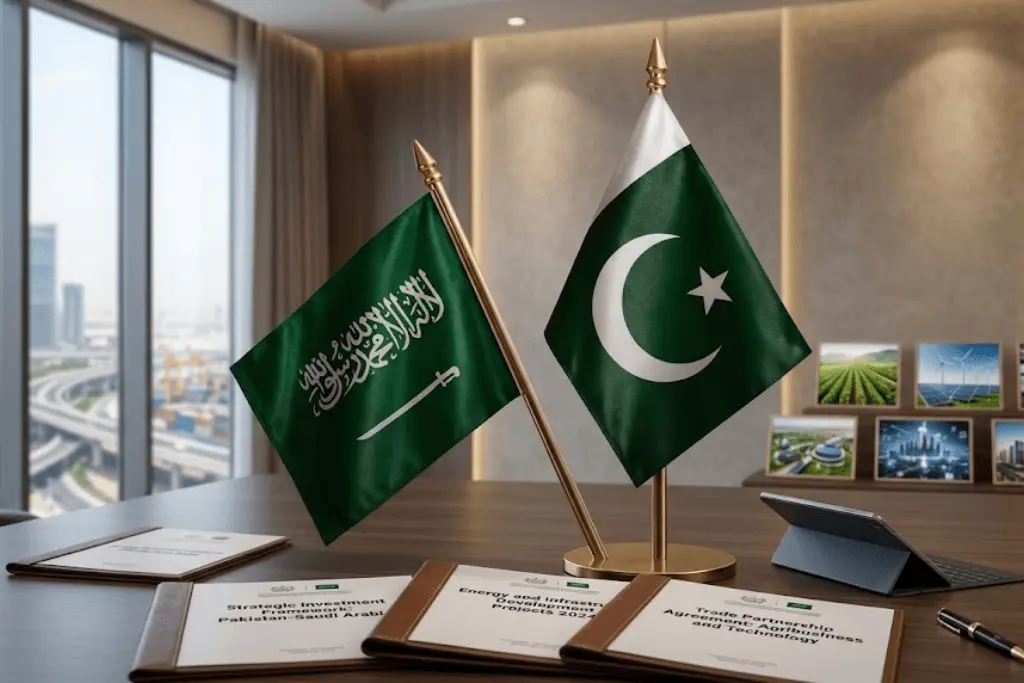
Prime Minister Shehbaz Sharif says Pakistan is seeking to broaden its long-standing ties with Saudi Arabia into a wider Pakistan Saudi Arabia economic partnership, citing opportunities for enhanced investment and commercial collaboration. The move comes as both countries seek to expand their cooperation beyond traditional trade and develop links between their private sectors.
Sharif, who met a high-powered Saudi business delegation in Islamabad, stressed the need to develop economic ties that would be mutually beneficial. The talks concentrated on investment opportunities in agriculture, infrastructure, energy, information technology and other sectors that can help sustain long-term economic growth.
Pakistan, Saudi Arabia Want Deeper Economic Ties
The meeting of Prime Minister Shehbaz Sharif with the Saudi delegation highlighted the country’s increasing emphasis on attracting foreign investment and building stronger economic ties. The Saudi-Pak Joint Business Council’s delegation was led by Prince Mansour bin Mohammad Al Saud, providing an important platform for dialogue between business communities and policymakers.
The shift away from traditional trade relationships to a strategic economic partnership could put more weight on investment, joint ventures and private-sector participation. This cooperation can also help build deeper commercial linkages between Pakistani companies and Saudi investors and unlock additional opportunities in a variety of industries.
Pakistan and Saudi Arabia already share long-standing diplomatic, cultural and economic relations. A more robust investment-promotion framework could add a new dimension to that relationship by promoting sustained capital flows and projects that are aligned with Pakistan’s development priorities.
The focus on win-win cooperation is also indicative of Pakistan’s efforts to market the economy as an investment destination in the region. Greater confidence in investment facilitation, infrastructure development and policy coordination could increase Saudi commercial activity expansion in Pakistan.
Saudi Investors Keen On Pakistan’s Key Sectors
Agriculture was one area where Saudi Arabia saw investment potential. Pakistan’s large agricultural base and extensive farming communities and opportunities for modernisation provide scope for cooperation involving technology, food processing, supply chains and productivity improvements.
Investment in agriculture could enhance Pakistan’s ability to produce value-added products and improve linkages between farms, processing facilities and domestic and international markets. Saudi involvement could also help Pakistan’s efforts to modernise agricultural methods and encourage greater private-sector involvement.
Another big area of interest is infrastructure, with Saudi businesspeople looking at opportunities in ports, highways and outsourcing airports. Projects such as these could improve connectivity, but also facilitate commerce and build the infrastructure necessary for long-term economic growth.
Real estate development has also been mentioned as a potential area of investment. Well-designed projects in this sector have the potential to contribute to urban development, construction activity and employment, as well as underpinning wider demand for related services and materials across the Pakistani economy.
Further Partnership Opportunities Lie In Energy And IT
Energy and power distribution continue to be at the heart of Pakistan’s economic priorities, and the sector remains an important potential area for Saudi investment. More investment could assist in improving the energy infrastructure and create an enabling environment for more reliable electricity distribution.
The Saudi role in the energy sector could also lead to long-term commercial partnerships involving infrastructure, technology and operational expertise. More investment here would be relevant to growing industry because reliable energy remains an important underpinning for manufacturing and business activity.
Another avenue for cooperation is information technology, especially as Pakistan develops its digital economy and technology workforce. Regional technology markets could be boosted by investment in technology firms, digital services and related infrastructure.
The IT industry also offers opportunities that go beyond physical investment. Pakistani tech companies and Saudi firms can partner to transfer knowledge, export services and develop new digital businesses, adding more depth to bilateral economic relations.
Pakistan Speeds Up Work On $5 Billion Investment Package
Pakistan and Saudi Arabia are also pushing to accelerate progress on a previously agreed $5 billion investment package. The scheme is an important part of the efforts to intensify economic cooperation and to move toward realising large-scale investment opportunities.
The package is especially important when considering Pakistan’s overall strategy to attract foreign capital into productive sectors. Economic activity can be underpinned by investment in agriculture, energy, infrastructure and technology, providing opportunities for domestic firms and workers.
Prime Minister Shehbaz Sharif has said that the Pakistani government would fully support the investment projects of Saudi Arabia. The support aims to improve coordination of investors with relevant government institutions and reduce delays that can impede major projects.
Sifc Support Could Benefit Pakistan’s Investment Climate
The Special Investment Facilitation Council has been created as an important mechanism to improve investment facilitation in Pakistan. It could see greater coordination in Saudi-backed projects as businesses assess opportunities across provinces and economic sectors.
This is particularly the case with large infrastructure and industrial investments, which normally involve multiple approvals and coordination among institutions. For Pakistan, the larger goal goes beyond attracting individual investments. More active investment facilitation would help to create a more predictable business environment, stimulate reinvestment and help to build longer-term relationships between Pakistani companies and foreign investors.
So Saudi investment could be part of a broader effort to shore up Pakistan’s economic foundations. More participation of established international businesses can bring capital, technical expertise, management experience and access to wider commercial networks.
Pakistan Strategic Partnership Could Boost Trade, Investment
Moving closer economically with Saudi Arabia could matter beyond individual projects. Transparent project structures and effective facilitation could turn political goodwill into tangible economics through successful implementation of investment agreements.
Pakistan, Saudi Arabia Eye Long-Term Economic Partnership
The latest talks indicate a desire to cement and make more enduring the economic ties between Pakistan and Saudi Arabia. Instead of just looking at traditional trade, both sides are looking at investment opportunities that can build longer-term ties between businesses and institutions.
Pakistan’s willingness to facilitate Saudi investment provides an important basis for this next stage. The involvement of the Special Investment Facilitation Council and government support could help to overcome practical issues as projects move from talks to implementation.
The focus on agriculture, infrastructure, energy, real estate and information technology also lays a diversified basis for cooperation. A well-diversified investment portfolio can create opportunities in different segments of the Pakistani economy and reduce dependence on any one sector.
The next step will depend on how the projects are implemented, on investor confidence and on continued coordination between the two governments and their business communities as work continues on the $5 billion package of investment. A successful economic partnership could further deepen one of Pakistan’s most important regional relationships while strengthening its investment landscape.