Farhan Qureshi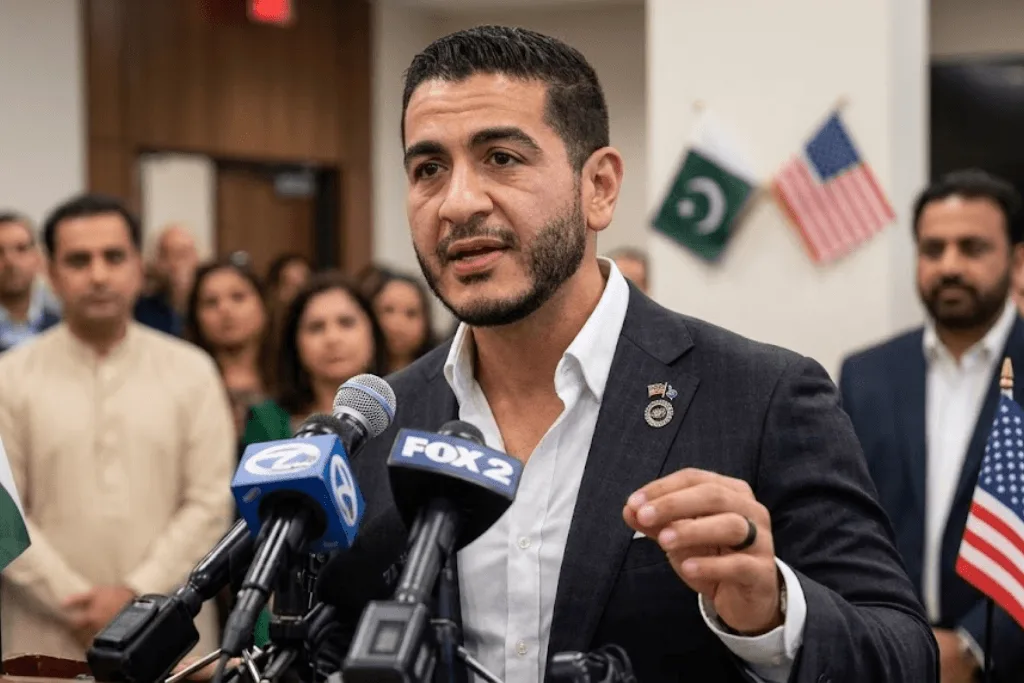
Speaking at a Pakistani-American community gathering in Michigan, Michigan Democratic U.S. Senate nominee Abdul El-Sayed raised concerns about the future of democracy in Pakistan, the role of the military and political freedoms. His remarks bring Pakistan’s internal political discourse into a larger conversation about democratic institutions and civilian rule.
Abdul El-Sayed’s Concern For Pakistan’s Democracy
El-Sayed’s remarks were directed at the nexus between the political institutions of Pakistan and the dominance of the military. Democratic institutions need room to breathe, and he wondered if political freedoms were being properly safeguarded. The country has experienced episodes of direct military rule punctuated by long periods of elected civilian governments, and the dynamics between civilian and security institutions are a central feature of its political history.
Military Role Still Part Of Pakistan’s Political Discourse
Throughout its history, the security environment of Pakistan and its strategic location in South Asia have assured the military a prominent place in national affairs. Advocates of a solid security apparatus often cite the importance of national defence and regional issues, whereas opponents call for increased civilian control.
The relationship has changed over different political periods. There has been an alternation between military governments and elected administrations and a gradual broadening of the role of civilian institutions in government and public administration.
Imran Khan’s Jailing Takes Centre Stage In Criticism
El-Sayed spoke about political freedoms in Pakistan, citing the case of former Prime Minister Imran Khan, who has been jailed. Mr Khan is still one of the main political figures in Pakistan and still attracts a great deal of political attention.
Khan and other party leaders have faced political pressure, his Pakistan Tehreek-e-Insaf party said, while Pakistani authorities have said legal action should follow the country’s judicial framework.
These opposing views have sparked intense political debate. His supporters say his arrest is part of a wider political struggle, while authorities have pointed to the legal issues in the cases brought against him. Political participation has been a hallmark of Pakistan’s public life. Elections, parliamentary debates, political campaigns and civic discussions are means through which citizens can express competing views.
Political Freedoms Important For Pakistan’s Image In The World
Political liberties have become an increasingly important ingredient in the international perception of Pakistan. The rhetoric around elections, opposition politics, media space and civil liberties can affect how foreign governments and international organisations assess developments in the country.
But Pakistan’s reputation around the world is about a lot more than political disagreements. The country is still a major regional player with broad economic, diplomatic and security ties throughout Asia, the Middle East and the wider international community.
Pakistani-American Community Takes Debate International
The Pakistani-American community has established important cultural, professional and economic ties with both Pakistan and the United States. Community groups and public events often focus on issues of Pakistan’s heritage, politics, economic development and bilateral relations.
The Michigan gathering was an opportunity to discuss the 79th anniversary of Pakistan. Such moments are often a cocktail of cultural identity and pondering about the history and future of Pakistan.
Political comments made at such events can resonate beyond the immediate crowd, particularly by candidates running for elected office in the United States.
US Aid To Ukraine A Matter Of Wide-Ranging Policy Debate
El-Sayed also asked whether US taxpayer money should be used to prop up governments accused of cracking down on political freedoms. The argument connects Pakistan to a larger debate in the United States about foreign aid and democratic values.
American foreign policy has too often been a balancing act between strategic interests and concerns of governance and human rights. Historically, Pakistan has been an important partner for Washington on regional security, counterterrorism and diplomatic issues. Stable governance can facilitate long-term economic planning, infrastructure investment and public sector reform.
Institutional cooperation is also important due to Pakistan’s federal structure. The federal government and the provinces share responsibility for the main areas of public policy and, thus, political coordination is essential for effective government.
A stable political environment can add more certainty for business, investors and development institutions. It may also mean governments can focus more consistently on education, health, infrastructure and employment.
Abdul El-Sayed’s Comments Open The International Debate On Pakistan
Abdul El-Sayed’s criticism has brought military influence, political freedoms and the imprisonment of Imran Khan into an American political discussion. His comments at a gathering of Pakistani-Americans also illustrate how Pakistan’s domestic political issues are drawing more interest from communities and political figures abroad.
The remarks also highlight the continued salience of civil-military relations in Pakistan’s political discourse. The country has real security challenges that require strong national institutions, but democratic governance is dependent on clearly functioning constitutional mechanisms.