Urooj Niazi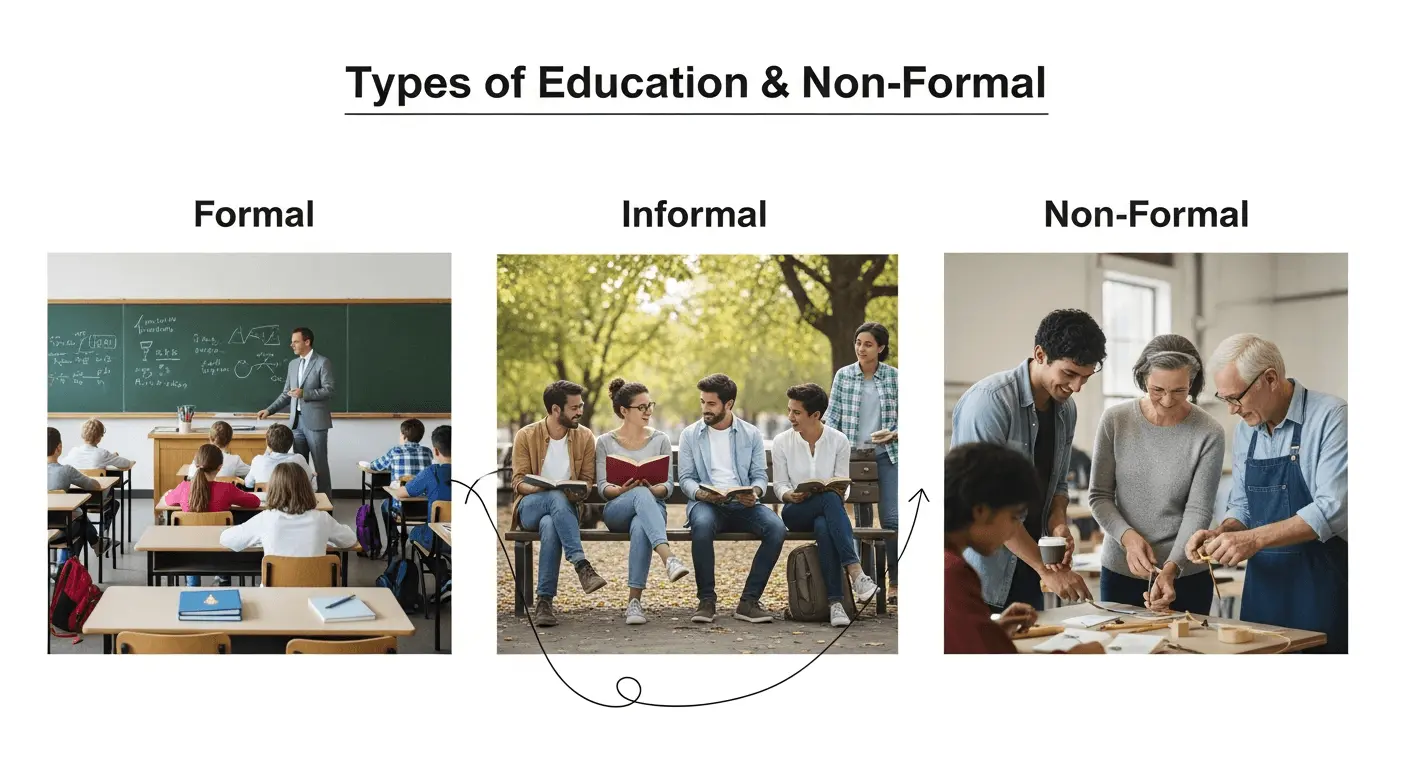
The types of Education is vital in the development of individuals, society, and economies within the world. From childhood education to professional skills development, education shapes the way individuals think, communicate and give back to the community. With time, various systems and orientations towards education have changed to suit various learning requirements. The understanding of the nature of education can help the learners, parents, and policymakers to make the most optimal decisions in order to be able to attain personal and social growth. As a rule, it is possible to define education as formal, informal, and non-formal, and each of them has its purpose. Together, these types of education will encourage lifelong learning and adaptability in a rapidly evolving world.
Formal Education: Systematic and institutional Learning
Formal education is the most used and most familiar type of education. It is systematic, and it is taught in institutions as schools, colleges, and universities. Such education usually begins at the primary school level, then moves on to secondary and higher levels.
One of the principal features of formal education is the standardized system of evaluation, including examinations, grades, and certifications. Career progress and graduation often require such qualifications. Knowledge is also instilled in the learner through intensive learning in subjects such as mathematics, science, languages, and social studies, among others, in formal education. Through its formal education system that imparts a disciplined learning environment, education encourages critical thinking, problem-solving, and academic development.
Nonetheless, formal education, as crucial as it can be, can not necessarily take care of personal learning styles and practical abilities in every respect. It is in this regard that the other forms of education complement each other.
Informal Education: Types of Education Through Life Experiences
Informal education is the kind of education that takes place outside of formal classrooms and institutional structures. It is non-planned and non-organized and usually occurs as part of the day-to-day activities and interactions, as well as experiences. These can be the learning values of the family, the communication skills of the peer, or the problem-solving abilities of work and hobbies.
This kind of learning is life-long and ongoing, and it establishes the attitudes and beliefs of a person and their social skills. Formal education is particularly valuable in the formation of emotional intelligence, cultural awareness, and moral values. Despite a lack of certificates and degrees, informal education is highly effective in personal growth.
The digital era of modern society has diversified informal education via the Internet, social media, podcasts, and self-directed learning. With these sources, people can know something on their own, and hence, education has never been so accessible.
Non-Formal Education: Flexible and Skill-Centred Learning
Non-formal education is between formal and informal education. It is well structured and goal-oriented, but it lacks a strict academic framework. Such education comprises vocational training, adult literacy programs, workshops, and online certification courses.
Informal education has been especially helpful in the development of skills and career growth. It assists students in getting hands-on skills that can be directly used in the workplace. The non-formal education provides other means of learning to individuals who might not receive formal education in the process of economic and social empowerment.
Through emphasis on flexibility and relevance, non-formal education would supplement the traditional systems and help people of any age to pursue lifelong education. Click here to get more knowledge.